Key findings: Adult Social Care Funding 2022/23
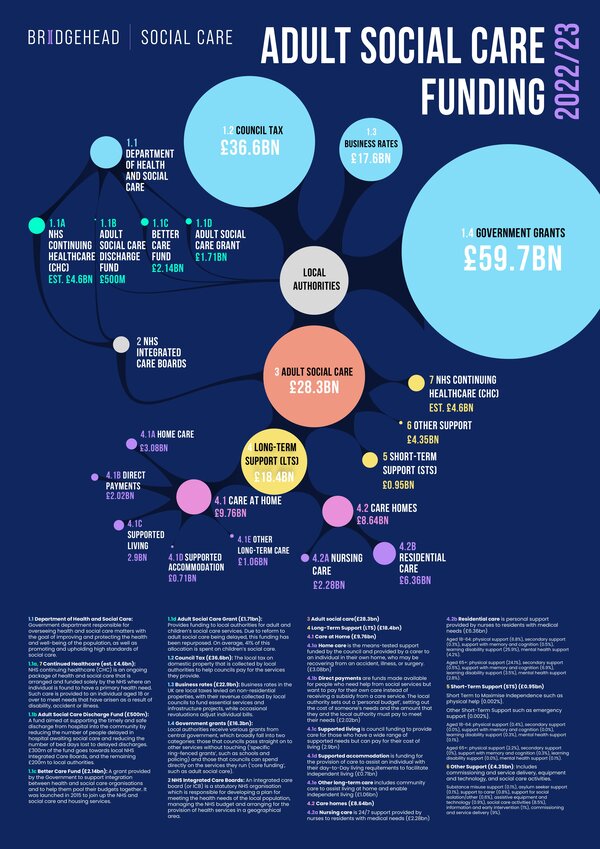
- Total adult social care spending in England reached £28.3 billion in 2022/23, with long-term support accounting for £18.4 billion (65% of the total).
- Care at home received £9.76 billion and care homes £8.64 billion of the long-term support budget, split primarily between home care (£3.08bn), supported living (£2.90bn), and residential care (£6.36bn).
- Within residential care (£6.36 billion), 37.8% of recipients are aged 65 and over against 37.7% aged 18-64; physical support is the leading primary support reason at 30.9%, followed by learning disability at 29.4%.
 Download report
Adult Social
Care
Funding
A visual guide to how adult social care is funded in England, tracing the £28.3 billion flow from central government and local authorities through to long-term and short-term care provision.
£28bn
total spend 2022/23
By the numbers
£28.3 billion. One year. Where it goes.
£28.3bn
Total adult social care spend, England 2022/23
65%
Of all spend goes to long-term support
£9.76bn
Care delivered in people's own homes
£4.6bn
NHS Continuing Healthcare, funded by the NHS
Key findings
What the data shows
Adult social care spend reached £28.3 billion in England in 2022/23 across all provision types.
Long-term support takes 65 per cent of the total: £18.4bn, nearly two-thirds of all spend.
Care at home (£9.76bn) and care homes (£8.64bn) are split almost evenly.
Home care is the single largest care-at-home component at £3.08bn, ahead of supported living.
NHS Continuing Healthcare (≈£4.6bn) is funded entirely by the NHS for those with a primary health need.
The Better Care Fund (£2.14bn) pools NHS and council budgets to join up health and social care.
Spend by support type
Total adult social care spend reached £28.3 billion in 2022/23. Long-term support accounts for the largest share at 65 per cent (£18.4bn), followed by other support at 15.4 per cent (£4.35bn) and short-term support at 3.4 per cent (£0.95bn).
The remaining share relates to NHS Continuing Healthcare (≈£4.6bn), which is funded by the NHS and flows separately from local authority budgets.
£28.3bn
Total ASC spend
65%
Long-term share
15.4%
Other support
3.4%
Short-term support
Long-term support: care at home vs care homes
Of the £18.4bn in long-term support, care at home (£9.76bn) and care homes (£8.64bn) are roughly equal in scale, a near 53:47 split.
The balance reflects a long-running policy shift toward supporting people to remain in their own homes wherever possible, rather than in residential settings.
£9.76bn
Care at home
£8.64bn
Care homes
53%
Home's share of long-term
Inside care homes: nursing vs residential
Of the £8.64bn spent on care homes, residential care (£6.36bn) accounts for nearly three-quarters. Nursing care (£2.28bn) covers those with more complex health needs requiring on-site nursing staff.
The 74:26 residential-to-nursing ratio reflects the overall population of care-home residents, the majority of whom do not require registered nursing.
£6.36bn
Residential care
£2.28bn
Nursing care
74%
Residential share
Inside care at home: where the £9.76bn goes
Home care (£3.08bn) and supported living (£2.9bn) are the two largest components of care-at-home spend, together making up well over half of the total.
Direct payments (£2.02bn) give service users cash to arrange their own support, putting control in the hands of the people who use care.
£3.08bn
Home care
£2.90bn
Supported living
£2.02bn
Direct payments
Who receives residential care: age and need
Within residential care (£6.36bn), the split by age is close to even: 37.8 per cent are aged 65 or over, against 37.7 per cent aged 18–64.
Physical support is the leading reported primary support reason at 30.9 per cent, followed by learning disability (29.4%), memory and cognition (7.4%) and mental health (7.0%).
37.8%
Residential care recipients aged 65+
30.9%
Residential care: physical support
29.4%
Residential care: learning disability
Other support: what the £4.35bn covers
The £4.35bn “other support” category encompasses commissioning and service management (£0.39bn), social care activities (£0.37bn), assistive equipment and home adaptations (£0.039bn), and carer support (£0.035bn).
The bulk of the category is a residual covering wider council social care overhead and services that do not fit the principal long-term or short-term classification.
£0.39bn
Commissioning / mgmt
£0.37bn
Social care activities
£0.035bn
Carer support
How councils are funded: the upstream picture
Local authorities draw revenue from three main sources: government grants (£59.7bn) remain the largest single stream, supplemented by council tax (£36.6bn) and business rates (£17.6bn).
Adult social care absorbs approximately £22bn of that total, around one-fifth of all local authority spending, making it by far the largest discretionary service councils must fund.
£59.7bn
Government grants
£36.6bn
Council Tax
£17.6bn
Business Rates
How the money flows
Six routes to a care budget
NHS Continuing Healthcare
Fully NHS-funded care for people whose primary need is a health need. It flows outside local authority budgets.
≈ £4.6bn · NHS-funded
Better Care Fund
A pooled budget that joins up NHS and council spending to support timely discharge and independence at home.
£2.14bn · NHS + council
Adult Social Care Grant
Ring-fenced central government grant to councils, helping them meet rising demand and provider cost pressures.
£1.71bn · Central grant
ASC Discharge Fund
Targeted funding to speed safe hospital discharge into community, home and short-term care settings.
£0.50bn · Discharge
Council-commissioned care
Local authorities commission most long-term care, funded through council tax, the adult social care precept and grant.
Local authorities
Self-funders
Many people pay for their own care, assessed against means-tested thresholds before any council support begins.
Private contribution
Central funding routes into local authorities
Central government channels social care funding through several routes. NHS Continuing Healthcare (est. £4.6bn) is the largest, funded entirely by the NHS.
The Better Care Fund (£2.14bn) integrates health and care, while the Adult Social Care Grant (£1.71bn) and ASC Discharge Fund (£0.5bn) provide further targeted support to councils.
£4.6bn
NHS CHC (est.)
£2.14bn
Better Care Fund
£1.71bn
ASC Grant
£0.50bn
Discharge Fund
Conclusion
Following the money is the first step to making the case for sustainable social care funding.
Adult social care in England absorbed £28.3 billion in 2022/23, with nearly two-thirds going to long-term support and the balance split almost evenly between care at home and care homes.
Mapping how funding flows, from NHS Continuing Healthcare and the Better Care Fund through to council-commissioned care and self-funders, shows where pressure is concentrated, and where reform could have the greatest effect.