Insight · Corporate
Are paid links still worth buying for SEO and AI search?

Managing Director, Bridgehead Communications
Published 9 min read
Our analysis of 59 UK PR and communications searches found AI Overviews cite pages with few or no links. Why paid links are a poor buy in 2026, and when paying for a placement still makes sense.
Key findings
- In 59 UK PR and communications searches (Ahrefs, October to November 2026), 54% of top-ten results had fewer than 10 referring domains, and 21% had none.
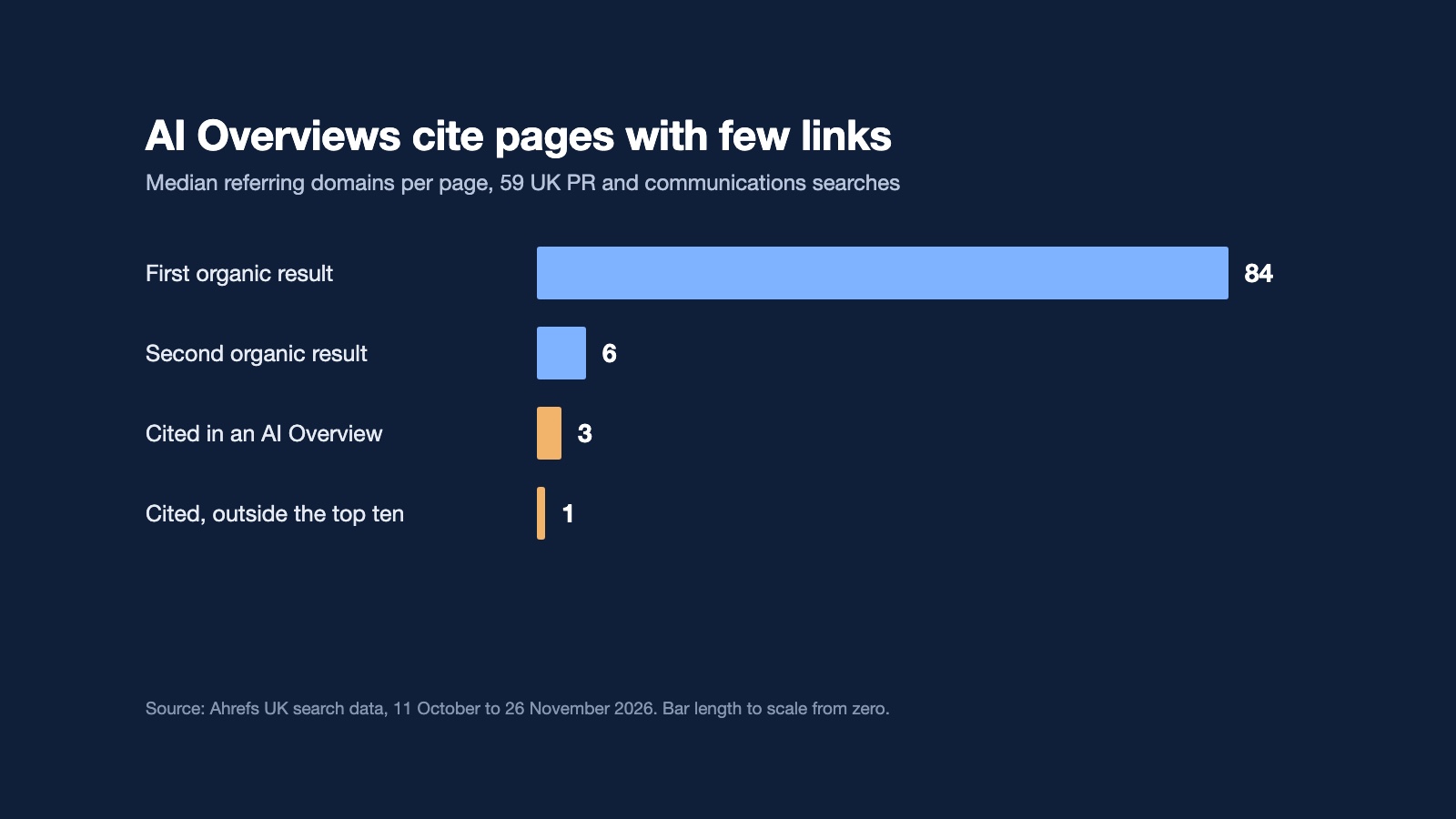
- Google showed an AI Overview on 48 of the 59 searches. Its 456 citations went to pages with a median of three referring domains; 202 came from pages outside the organic top ten, with a median of one.
- Two Bridgehead pages with no referring domains are the fourth organic result for "b2b pr agency" and "what is public affairs", and both are cited in the AI Overviews for those searches.
- Of the 1,398 linking domains Ahrefs returned for the Bridgehead website, 1,305 are on our disavow file. Our Ahrefs Domain Rating rose from 15 to 38 between September and November 2026, while 933 new linking domains appeared, 925 of them on our disavow file.
- A link insertion costs $179 on average across 41,783 sites on a major link marketplace, and $461 on sites rated DR 80 or above (BuzzStream, updated August 2026).
Paid links are not worth buying for Google rankings or for AI citations in 2026, unless you are paying for an audience and label the placement as advertising. Google's spam policies class "buying or selling links for ranking purposes" as link spam, and since December 2022 its SpamBrain system has been used to "neutralize the impact of unnatural links". In our analysis of 59 UK PR and communications searches, the pages cited in Google's AI Overviews had a median of three referring domains, one fewer than the top-ten pages the Overviews passed over. Paying for editorial coverage without saying so also carries legal risk in the UK, where the Digital Markets, Competition and Consumers Act 2024 lists it among practices unfair in all circumstances.
What counts as a paid link, and what does Google say about it?
A paid link is any link you get in exchange for money, a product or a favour: a sponsored guest post, a "link insertion" into an existing article, an advertorial, a directory upgrade. Google's spam policies (last updated 23 November 2026) list "exchanging money for links, or posts that contain links" and advertorials "where payment is received for articles that include links that pass ranking credit" as link spam. The same page names links with optimised anchor text in guest posts and press releases.
Buying a link is not itself the offence. Google accepts that paid links are "a normal part of the economy of the web for advertising and sponsorship purposes", provided they carry a rel="nofollow" or rel="sponsored" attribute. Those attributes tell Google not to pass ranking credit, which removes the only reason most people buy the link.
When the link is not labelled, Google has two responses. The algorithmic one dates from the December 2022 link spam update, when Google said SpamBrain "can now detect both sites buying links, and sites used for the purpose of passing outgoing links" and would discount them. The manual one is the "unnatural links" action in Search Console, which still applies to buyers and sellers. Google has not run a link-specific update since 2022, though its status dashboard records general spam updates as recently as September 2026.
Do links still move Google rankings?
Links still count, but far less than the link market prices them. Google's own documentation now says it uses links "as a signal" for relevance. In March 2024 it removed the word "important" from the sentence on links in its spam policies, as Search Engine Journal reported at the time. A month later Google's Gary Illyes told SERP Conf, as relayed by Patrick Stox, that Google needs "very few links to rank pages".
Our data points the same way. We pulled the UK top ten for 59 searches a PR or communications buyer might make, from "pr agency london" to "what is crisis management", and counted live referring domains for every ranking page.
- 54% of the 511 top-ten results had fewer than 10 referring domains, and 21% had none.
- The number-one result had a median of 84 referring domains, but the result in second place had a median of six.
- In 44 of the 59 searches, the top result ranked above at least one page with more referring domains.
- Across the 59 searches, the average rank correlation between position and referring domains was 0.27, where 1 would mean links decide the order entirely.
The first-place figure is pulled up by agency homepages and Wikipedia, which collect links over years. Raw link counts are also polluted, as our own profile shows below. A purchased link adds to a count that is already weak at predicting who ranks.
Do links get you cited in AI answers?
Not in the searches we measured. Google showed an AI Overview on 48 of the 59 searches, including 17 of the 28 searches for agencies and services. We counted 456 citations in those Overviews and checked the links behind each cited page.
- Cited pages had a median of three referring domains. Top-ten pages the Overview did not cite had a median of four.
- 31% of cited pages had no referring domains at all.
- 202 of the 456 citations went to pages that did not rank in the organic top ten. Those pages had a median of one referring domain.
- YouTube took 89 citations, almost one in five.
Two of the cited pages are ours. The Bridgehead B2B PR page is the fourth organic result for "b2b pr agency" (sixth on the page once search features are counted) and is cited in that Overview. Our explainer What is public affairs? holds the same place for "what is public affairs" and is cited for that search and for "public affairs". Ahrefs records no referring domains to either page.
This shows that a page does not need many links to be cited. It does not show that links never help, and it covers Google's AI Overviews on UK PR searches, not every engine or sector.
Several larger studies point the same way. Ahrefs' study of 75,000 brands (May 2025) found that branded web mentions correlated with AI Overview visibility at 0.664, against 0.218 for the number of backlinks. Muck Rack's October 2026 report on AI citations found that more than 84% came from earned and third-party sources, and that content identifiable as paid or advertorial made up 0.3% of citations in September 2026. Google's AI optimisation guide says optimising for its AI features "is optimizing for the search experience, and thus still SEO", and that "seeking inauthentic "mentions" across the web isn't as helpful as it might seem".
The evidence is not unanimous. SE Ranking's model of 129,000 domains (November 2025) found referring domains the strongest predictor of ChatGPT citations, though it does not disclose the period or model version. A Seer Interactive study of 62 brands found strong correlations between authority metrics and ChatGPT citations in travel, and asks whether every such correlation is really measuring how big and well known the brand is. Big brands have links and mentions, and AI engines cite big brands. Buying links does not make you one.
What happens when the paid-link market points at you?
We have seen the output of the paid-link trade at close range, because from spring 2026 it has been aimed at the Bridgehead website. It peaked in September. Networks of throwaway domains with names built from "seo", "rank" and "backlink" have linked to us by the thousand, alongside a separate run of anchor-text spam from compromised WordPress sites. We have not paid for any of it, and we refresh our disavow file every week.
- Ahrefs counts 1,520 live referring domains to the Bridgehead website (25 November 2026). Of the 1,398 it returned to us, 1,305 (93%) are on our disavow file.
- 933 of those domains first appeared in September 2026. 925 of them are on the disavow file.
- Our Ahrefs Domain Rating was 15 on 1 September, 32 on 1 October and 38 on 25 November.
Link prices rise with Domain Rating. BuzzStream's analysis of a major link marketplace (updated August 2026) found that a link insertion costs $179 on average across 41,783 sites with full price data. On sites rated 80 or above the average is $461. Our own rating more than doubled in under three months, and the rise coincided with a wave of links we never wanted. A third-party authority score that can move like that is a poor basis for setting a price.
Our UK clicks from Google Search also rose over the same period, from 308 in August to 886 in October. We published dozens of new Insights and fixed several crawl and indexing faults in those months, so we cannot attribute that rise to the links, or rule them out. Google says it neutralises unnatural links algorithmically and keeps manual actions for flagrant cases, and Rand Fishkin's reading of the 2024 API leak is that links from its low-quality tier are "merely ignored".
Can you buy your way into AI answers instead?
Some firms now pay to appear in "best X" lists in the hope that ChatGPT or Perplexity will cite them. Lists do get cited. Peec AI found that about one in ten AI citations for software-review prompts (December 2025 to February 2026) came from vendors' own self-promotional listicles, with "no evidence of algorithmic correction". Kevin Indig wrote in Search Engine Land (August 2026) that paid placement in "objective" listicles is something "Google cannot detect".
In the UK, a regulator can act on it. Schedule 20 of the Digital Markets, Competition and Consumers Act 2024 lists among practices "in all circumstances considered unfair" the use of editorial content to promote a product "where a trader has paid for the promotion without making that clear". The CAP Code requires advertorials to be labelled, for example as an "advertisement feature". In February 2026 the ASA upheld a complaint against Zava over a paid article on Mumsnet whose only label was a small "Created by Zava" line. A paid slot in a consumer-facing list presented as independent editorial carries the same exposure. Whether a particular B2B placement falls within the Act is a question for a lawyer, and nothing here is legal advice.
Google also polices the publishers that sell such slots. Its site reputation abuse policy targets third-party content placed on a host site to borrow its ranking signals, and Google said in November 2024 that "no amount of first-party involvement" changes that. Since 30 August 2026 those manual actions no longer apply to searches inside the EEA, after talks with the European Commission. The UK is outside the EEA, so they still apply to UK results.
When is paying for a placement worth it?
When you would pay for it with no link at all. A sponsored feature in a trade title your buyers read, a stand at the right conference, a listing on a review platform where clients can leave verified reviews: each can earn attention and mentions that AI engines and people pick up. Label it as advertising, mark any link rel="sponsored", and judge it on the audience it reaches.
The money that used to go on link packages is better spent on material other sites want to cite: original data, named expert comment and stories journalists will cover. Earned coverage is what the Ahrefs and Muck Rack studies associate with AI visibility, and it is what turned up in the AI Overviews we measured.
How we did this
We chose 85 UK searches across PR, public affairs, reputation and crisis communications: 45 agency and service searches and 40 informational ones. On 26 November 2026 we pulled the latest stored UK search results for each from the Ahrefs API, which records organic positions and the pages cited in Google AI Overviews. 21 searches had no stored results in Ahrefs and five had results older than October 2026; we excluded those, which left 59 (28 agency and service, 31 informational), captured between 11 October and 26 November 2026. For each of the 617 distinct top-ten and AI-cited URLs we took Ahrefs' live referring-domain count for that exact URL on 25 November 2026. "Top ten" means the first ten organic results, excluding SERP features. Correlations are Spearman rank correlations computed within each search and averaged. AI Overview citations are counted once per search and URL. Ahrefs captures one snapshot per search, and AI Overviews change between visits, so the citation figures describe that snapshot.
The Bridgehead link figures come from Ahrefs' referring domains report for bridgeheadcommunications.com and its subdomains (live links, pulled 26 November 2026). The API returned 1,398 of the 1,520 domains Ahrefs counts; it did not return the other 122. We matched them against our disavow file of 1,892 domains submitted to Google Search Console on 24 November 2026. Search Console clicks are UK web search by calendar month, read through Ahrefs' Search Console integration. Analysis and drafting were assisted by AI and checked by the author against the sources listed.
Sources and method
- Spam policies for Google web search, Google Search Central (Updated 23 November 2026)
- December 2022 link spam update, Google Search Central Blog (14 December 2022)
- Google Search ranking updates history, Google Search Status Dashboard (Accessed 26 November 2026)
- Optimising for generative AI features in Google Search, Google Search Central (Updated 10 July 2026)
- Updating our site reputation abuse policy, Google Search Central Blog (19 November 2024)
- Updating our site reputation abuse policy (EEA), Google Search Central Blog (28 August 2026)
- Google March 2024 update: 4 changes to link signal, Search Engine Journal (5 March 2024)
- Google: we need very few links to rank pages, Search Engine Roundtable (22 April 2024)
- An anonymous source shared thousands of leaked Google Search API documents, SparkToro (28 May 2024)
- AI Overview brand correlation study (75,000 brands), Ahrefs (26 May 2025)
- What is AI reading? October 2026, Muck Rack (28 October 2026)
- What if the best GEO strategy is the one you stopped investing in?, Seer Interactive (30 March 2026)
- ChatGPT citation factors, SE Ranking (24 November 2025)
- Link insertion costs, BuzzStream (Updated 18 August 2026)
- Self-promotional listicles: analysis of 232k citations, Peec AI (3 March 2026)
- Has Google demoted listicles?, Search Engine Land (Kevin Indig) (26 August 2026)
- Digital Markets, Competition and Consumers Act 2024, Schedule 20, legislation.gov.uk (2024)
- ASA ruling on Health Bridge Ltd t/a Zava, Advertising Standards Authority (18 February 2026)
- UK SERP, AI Overview and referring-domain data for 59 searches; Bridgehead referring domains, Bridgehead analysis of Ahrefs API data (26 November 2026)