Insight · Corporate
How to lay out a service landing page that ranks and sells
Managing Director, Bridgehead Communications
Published 12 min read
Where to put proof, how much text to write and which pages to link. Evidence from eye-tracking, Google and 675 visits to ten Bridgehead service pages.
Key findings
- On the ten Bridgehead service pages (675 human visits, 90 days), 2.1% of visits went on to a case study, 0.9% to a contact page and 0.9% to an insight. Median time on page was under 15 seconds on seven of the ten pages.
- Removing navigation lifted conversion in HubSpot's tests on five of its highest-traffic landing pages (0% to 28%). HubSpot does not say where that traffic came from. Our reading is that the result does not transfer to an organic service page, which has to rank and therefore has to link.
- Search and AI engines and readers reward overlapping choices: an answer early, headings that match the question, named evidence in the first third of the page (ChatGPT citation data), and internal links with varied anchors (Zyppy).
- The evidence on length pulls two ways. Unbounce's benchmark data for campaign landing pages favours short copy (a best range of 275 to 745 words in professional services). Backlinko's study of 11.8 million results puts the average top-10 page at 1,447 words. Neither tests an organic service page, so the ranges below are Bridgehead's judgement and are untested.
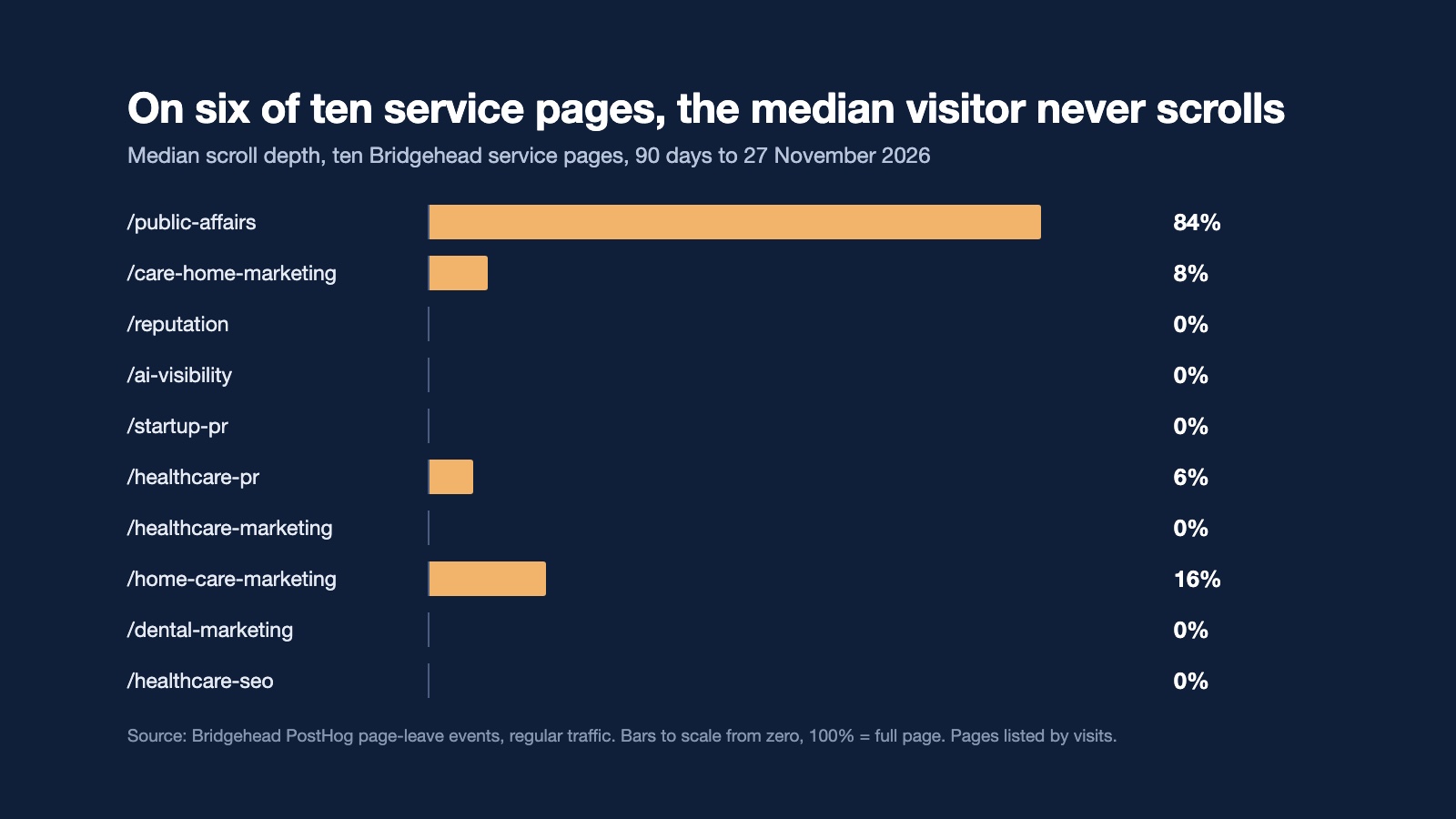
A service landing page is the one URL that answers one buyer question about one service and moves the reader to a next step. Put the promise, the proof and the action in the first two screens. Nielsen Norman Group's eye-tracking study (2018, 120 participants, over 130,000 fixations) found that 57% of viewing time falls above the fold and 74% in the first two screenfuls. Length matters less than most advice claims: Google says it has no preferred word count. The bigger risk is that visitors leave before they reach anything you wrote. In the 90 days to 27 November 2026, 79% of human visits to ten Bridgehead service pages ended without a second page view, and the median visitor on six of the ten pages never scrolled.
Is a service page the same thing as a paid landing page?
No, and the evidence on one does not carry over to the other.
A campaign landing page exists to convert one click from one advert. Removing the site navigation tends to help there. HubSpot ran the test on five of its own highest-traffic landing pages and reported conversion lifts of 0% to 28%, with the largest (16% and 28%) on middle-of-funnel offers and 0% to 4% on top-of-funnel pages. HubSpot does not say whether the traffic was paid, so the distinction between campaign and organic pages is our argument and not HubSpot's. Yuppiechef's widely quoted doubling (3% to 6%) from removing its menu is a single test on a single page.
An organic service page has a different job. It has to rank for a commercial query, be retrievable for the sub-questions an AI answer fans out into, and then persuade someone who may be comparing four agencies. Internal links are part of how it does the first two. Zyppy's analysis of 23 million internal links found pages with 40 to 44 inbound internal links earned about four times the Search Console clicks of pages with 0 to 4, with the benefit falling away past roughly 50. That is correlational, and anchor-text variety was the strongest relationship in the data.
Our position: keep the navigation and the internal links on organic service pages. Build a separate, stripped-back variant for any page that paid campaigns point at, and keep it out of the index.
What order should the sections run in?
The order below follows where attention falls. Nielsen Norman Group found more than 42% of viewing time in the top fifth of a page and more than 65% in the top two fifths. Kevin Indig's analysis of 18,012 ChatGPT citations found 44.2% came from the first 30% of the page, which is a 1.47 times over-representation and not a sign that the rest is ignored.
| Position | Section | Its job | Rough size |
|---|---|---|---|
| 1 | Hero | H1 states the question or claim; one sentence of promise; one primary action; one sourced number | First screen |
| 2 | Direct answer | Defines the service in definitional phrasing ("X is"); one number with source and date | 100 to 150 words |
| 3 | Who it is for | Names the buyer and the situation, so the right reader recognises themselves | 80 to 150 words |
| 4 | What we do | Three to five components, each with its proof inline: a client, a figure, a named outcome | 400 to 600 words |
| 5 | Who does the work | Named people, credentials, real photographs | 100 to 200 words |
| 6 | Case studies | Two or three relevant cards, two abreast | Cards, no prose |
| 7 | Questions buyers ask | Four to six, answer in the first sentence, none repeating the body | 250 to 400 words |
| 8 | Related pages | Four to six links with descriptive anchors | Links |
| 9 | Closing action | The same action as the hero | One line and a button |
This is a Bridgehead recommendation, not a tested optimum. The sizes sum to roughly 1,000 to 1,500 words, which matches the middle of our existing pages.
Proof sits inside the section it supports, and does not go in a sidebar. A right-hand rail stacks to the bottom on mobile. We chose inline proof over a sidebar in October 2026 after reviewing our own behaviour data (see the audit below), and it is a design judgement that we have not tested.
How much text should it carry?
Search gives no target. Google's guidance on helpful content answers "do you have a preferred word count?" with "No, we don't", and its guide to generative AI features (May 2026) says chunking and rewriting for AI are unnecessary. Backlinko's analysis of 11.8 million results found no direct relationship between word count and ranking, yet its average top-10 page ran to 1,447 words and it notes long content can help a page reach page one.
Conversion data points the other way. Unbounce's 2024 benchmark names a best-performing range of 275 to 745 words for professional services and suggests aiming for about 500. An earlier edition for business services said word count and reading ease did not relate to conversion, then put the sweet spot below 300 words. Those figures come from campaign landing pages built on Unbounce, which have a narrower job than an organic service page.
The two bodies of evidence are reconcilable. Nielsen Norman Group's attention data says 74% of viewing time falls in the first two screenfuls, so a service page can behave like a short campaign page there and carry the longer, rankable body below it. That is a design inference, not a tested result.
What the evidence does support is scope discipline. A page that answers the question its URL stands for, and the sub-questions that belong to it, gives an answer engine a clean passage to lift and gives a buyer a short route to a decision. A page that tries to answer every adjacent question dilutes both.
Our range for an organic service page is 900 to 1,500 words, front-loaded, with the first two screens able to stand alone. Go past that only when each added section answers a question a buyer would otherwise take to a competitor. Bridgehead's ten service pages run from 904 to 2,762 words (median 1,293). Scroll depth does not track length across them, and ten pages is too few to test it.
How many images, and which kind?
Nielsen Norman Group's eye-tracking research separates images that carry information from images that decorate. Photographs of real people who work at the organisation, product shots and charts are scrutinised. Generic stock photography and large feel-good images are ignored. In one NN/g example, a participant spent about 10% more time on portrait photographs than on the biographies beside them, though the biographies took 316% more space.
That is the case for named people, real client photography and press cuttings, and against filler. Charts that carry the page's own data belong in the same group, although NN/g's article does not test them. We found no controlled study of how many images a service page should hold, and the conversion claims for imagery come almost entirely from vendor blogs. Treat image count as a by-product of how much proof you have.
Two practical limits. Every image needs descriptive alt text (Google's image SEO documentation explains why), and Google's generative AI guide recommends images and video where they are relevant. And weight costs conversions: Portent's analysis of 20 sites (14 of them B2B lead-generation) and a 5.6 million-session page-speed sample found a B2B site loading in one second converted about three times as well as one loading in five. Other write-ups of the same study quote different multiples, so read the direction and not the number.
What should the page say for search and for AI answers?
Most of this is ordinary good practice, and Google's own documentation supports it.
- Title of 51 to 60 characters that mirrors the H1. Zyppy found Google rewrote 61.6% of 80,959 titles, rewrote titles over 70 characters 99.9% of the time, and replaced pipes twice as often as dashes. The healthcare-marketing page title is 59 characters and uses a pipe.
- An opening block that states the answer in definitional phrasing, with a sourced number. Indig found 36.2% of cited passages used "X is" phrasing against 20.2% of skipped introductions, and that cited passages read at about grade 16 against 19.1 for the uncited text around them.
- Headings written as the question a buyer would type. All ten Bridgehead pages already carry four to eleven question headings, which is the right form. Check each answer adds something the body has not already said.
- Content in the initial HTML. Non-Google AI crawlers do not execute JavaScript, so a tab or expander that renders client-side is invisible to them (Vercel and MERJ, "The rise of the AI crawler").
- Schema as hygiene only. Google says structured data is not required for generative features, and FAQ rich results ended in May 2026. Service and Breadcrumb markup that matches the visible page is fine.
Two facts shape how much weight to give AI visibility on a commercial page. First, Seer Interactive measured AI Overviews on 36% of informational queries, 8% of commercial queries and 5% of transactional ones, so a service page sits in the least exposed part of the results page. Second, Muck Rack's analysis of 25 million AI-cited links (May 2026) found around 84% of ChatGPT, Claude and Gemini citations went to earned media. Muck Rack sells PR software and does not publish how it classes a citation as earned, so read the direction and not the figure. Other work in our evidence study also finds third-party pages out-cite owned pages on ChatGPT and Perplexity. A service page therefore cannot win AI citation by itself. Its job is to be the page a buyer lands on after an engine or a journalist has named you, and to point to that third-party proof.
Bridgehead's own entry data agrees with the scale. Of 512 entry visits to the ten service pages, 271 were direct, 130 came from search engines, 105 from other referrers and 6 from AI assistants (1.2%). Conductor's 2025 figure for AI assistants across 1,215 enterprise domains was 1.08%.
What do visitors need from the page?
This is the half of the question that layout advice usually skips, and it comes first in practice, because search engines read the result of visitor behaviour. Judge Mehta's August 2024 findings of fact record that Google's Navboost memorises user click data over 13 months, and that newer language-model signals did not replace it. Our reading is that a page which ends the search is one visitors do not click back from. The ruling does not say that in terms.
They decide in seconds. Median time on page, from Bridgehead's page-leave events, was 3 to 14 seconds on seven of the ten service pages. The first screen must carry the whole case on its own: who this is for, what you do, one piece of proof, one action.
They read on a phone. Unbounce's 2024 benchmark reports that mobile visitors convert less often than desktop visitors in professional services (8.3% against 11.6% on its published rates), on about four times the traffic. Test the first screen at 390 pixels wide before any other width.
They want plain sentences. Unbounce reports that copy at a fifth to seventh-grade reading level converts best, at 12.9% in professional services (11.1% across all industries). Indig's data shows cited ChatGPT passages read at roughly grade 16. These do not conflict in practice: use short words and short sentences, and keep the proper nouns, figures and dates that make a passage citable.
They look for evidence and for cost. In Clutch's 2020 survey of B2B buyers, transparent cost information was the most important website element for 25% and case studies or testimonials ranked second at 23%. The survey is six years old and other surveys rank pricing far lower, so treat this as a prompt to decide a pricing stance for each service, not as a rule.
They want to see who they would work with. Named specialists with photographs answer the question every services buyer is asking. See the NN/g finding above.
What Bridgehead's ten service pages show
Method: live pages fetched on 27 November 2026 and counted from the main element (words, images, unique internal links). Behaviour from PostHog events for the 90 days to 27 November 2026, restricted to events classified as regular traffic (bots and AI agents excluded). Raw event queries, so Bridgehead team visits are not excluded. Page-leave events arrive for roughly half of page views, so scroll and time figures describe the visits that sent them. Images include logos and press tiles.
| Page | Words | Images | Internal links | Case study links | Insight links | Visits | Median scroll | Reached 75% |
|---|---|---|---|---|---|---|---|---|
| /public-affairs | 1,268 | 15 | 22 | 3 | 4 | 139 | 84% | 51% |
| /care-home-marketing | 2,762 | 14 | 21 | 3 | 4 | 132 | 8% | 19% |
| /reputation | 1,078 | 33 | 20 | 3 | 4 | 98 | 0% | 17% |
| /ai-visibility | 1,259 | 2 | 16 | 3 | 0 | 80 | 0% | 9% |
| /startup-pr | 904 | 44 | 14 | 2 | 1 | 73 | 0% | 10% |
| /healthcare-pr | 1,473 | 43 | 21 | 2 | 4 | 73 | 6% | 3% |
| /healthcare-marketing | 1,181 | 49 | 17 | 2 | 0 | 46 | 0% | 29% |
| /dental-marketing | 1,407 | 2 | 11 | 0 | 0 | 12 | 0% | 0% |
| /home-care-marketing | 1,739 | 12 | 17 | 2 | 1 | 12 | 16% | 33% |
| /healthcare-seo | 1,318 | 2 | 12 | 0 | 0 | 10 | 0% | 0% |
What the ten pages show:
- Of 675 visits, 142 (21%) were followed by another page view on the site. Fourteen went to a case study, six to an insight, six to a contact page and twelve to /team.
- /public-affairs is the outlier: median scroll 84% against 0% to 16% on the other nine. We have not isolated why. The October 2026 page review noted it carries a ticker of 14 wins, which none of the others do. Treat that as a hypothesis.
- Four pages have no insight links and two have no case-study links. Image count does not explain depth: /healthcare-pr has 43 images and 3% of leavers reaching 75% of the page, and /healthcare-marketing has 49 images and a 0% median scroll.
- Strategy-call dialogs opened 66 times across the whole site in the period and 9 times from these ten pages. Three of the 23 submissions came from them. Several pages have no
/contactlink in the main content, and the call to action may open the dialog instead. We have not checked which pages open the dialog and which link out.
What we would change first, in order:
- On the pages where the median visitor never scrolls (/reputation, /ai-visibility, /startup-pr, /healthcare-marketing, /dental-marketing and /healthcare-seo; the last two have seven page-leave events each), put one named proof point and the action inside the first screen.
- Add case-study cards to /healthcare-seo and /dental-marketing, and insight links to the four pages without them, placed beside the claim they support.
- Write the first screen for a 390-pixel viewport and re-check the title on /healthcare-marketing for a dash in place of the pipe.
How to test: at 10 to 140 visits a page a quarter, an A/B test cannot detect anything except a very large effect. Change one page, annotate the date, and compare strategy-call opens per 100 visits and median scroll over a full quarter against its own history.
How we did this
Bridgehead data: PostHog project 242768, events $pageview and $pageleave with $virt_traffic_type = Regular, 90 days to 27 November 2026, plus strategy_call_opened and strategy_call_submitted. Page audit by in-browser fetch of the ten live URLs on 27 November 2026.
AI assistance: researched and drafted with Claude; figures traced to the sources above. Accuracy check: run by a second model (Claude Opus) against the primary sources on 27 November 2026; its corrections are applied. FAQ rich-result withdrawal in May 2026 is confirmed from trade coverage only. Indig's 2026 study is read via Search Engine Land and Search Engine Journal.
Sources and method
- Scrolling and Attention, Nielsen Norman Group (2018)
- Not All Images Are the Same, Nielsen Norman Group
- Should you remove navigation from your landing pages?, HubSpot
- Yuppiechef navigation A/B test, Wingify (VWO)
- Site speed is (still) impacting your conversion rate, Portent
- Professional services conversion benchmark, Unbounce (2024)
- Business services conversion benchmark, Unbounce (Earlier edition, year unstated)
- B2B buyers most concerned about transparent costs, Clutch (26 February 2020)
- The science of how AI pays attention, Kevin Indig, via Search Engine Land (16 February 2026)
- Internal links study (23 million links), Zyppy
- Title rewrite study (80,959 titles), Zyppy
- AI Overview research, Seer Interactive (April 2026)
- 2026 AEO / GEO Benchmarks, Conductor (2026)
- What is AI reading, Muck Rack (May 2026)
- Search engine ranking study (11.8 million results), Backlinko
- The rise of the AI crawler, Vercel and MERJ (17 December 2024)
- AI features and your website, Google Search Central (10 December 2025)
- Optimizing your website for generative AI features, Google Search Central (May 2026)
- Creating helpful, reliable, people-first content, Google Search Central
- US v. Google, findings of fact (paragraphs 96 and 102), US District Court, District of Columbia (5 August 2024)
- Bridgehead page audit and PostHog events for ten service pages, Bridgehead analysis (27 November 2026)