Insight · Corporate
What makes a Facebook ad work for a PR agency in 2026?

Managing Director, Bridgehead Communications
Published 4 min read
A specific offer, varied creative and a measure of qualified enquiries. What the evidence says about Facebook ads for PR agencies, and what to test in Guernsey.
Key findings
- Meta says creative diversification, not niche targeting, is now the main lever for finding the right audience (Meta, 22 April 2025). Jon Loomer, an independent advertiser, advises broad ad sets and ads that vary by pain point and persona.
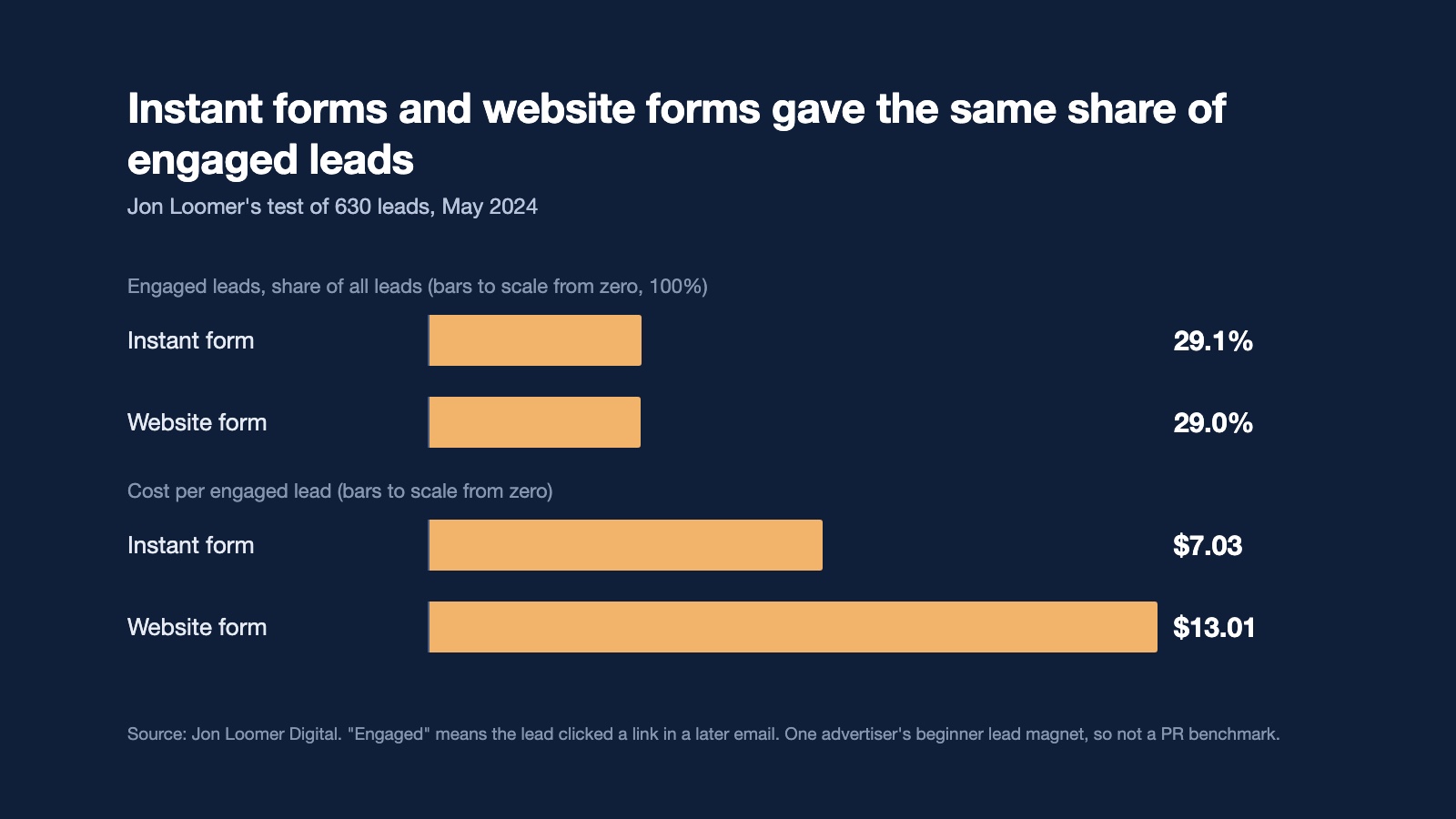
- Instant forms and website forms produced the same share of engaged leads in the best controlled test we found: 114 of 392 (29.1%) against 69 of 238 (29.0%). Instant forms cost $2.04 a lead against $3.77 (Jon Loomer, May 2024).
- No independent study isolates which creative traits drive B2B lead generation. Nearly all the published numbers come from agencies and software vendors selling the service.
- Guernsey has about 49,200 Facebook users (NapoleonCat, October 2026), so the same people will see the same ad repeatedly and a single creative will tire quickly.
- We found no published benchmark for PR agency Facebook ads in the Channel Islands, and no controlled study of them anywhere.
An effective Facebook ad for a PR agency makes one specific, checkable offer to a defined local audience, and the agency judges it by qualified enquiries rather than clicks. Meta's own advice points the same way: in an April 2025 post, Meta said the focus "has shifted from niche targeting to creative diversification as the best lever to find the most relevant audiences". In Guernsey the audience is small. NapoleonCat estimates 49,200 Facebook users on the island in October 2026. A PR advert there is a test of an offer, not a volume campaign.
What does an effective Facebook ad for a PR agency need to do?
It needs to name a problem the reader already has, offer something concrete and free, and say what happens next. A vague offer such as "book a free consultation" gives a stranger nothing to act on. For a PR firm a specific offer is a short written diagnostic: what shows when someone searches your business, whether AI tools such as ChatGPT name you, and what to fix first.
This is our view, not a measured finding: PR is bought on trust, so an ad that claims "award-winning PR" gives a stranger nothing to check. An ad that offers to check something gives them a reason to reply.
Does Meta's algorithm change how the ad should be built?
Yes, and mainly for the creative. Meta describes Andromeda, its ads retrieval system, as narrowing "tens of millions of ads to the few thousand we consider showing someone" (Meta, March 2025, quoted by Loomer). Meta's April 2025 post says to upload creatives that differ in theme and message. Loomer goes further and advises stopping the hunt for one perfect combination of copy and image, keeping ad sets broad, and varying ads by angle, format and persona. That second part is his advice, not Meta's.
Two cautions apply. Dentsu says duplicating ads with small edits is no longer enough. AdExchanger (Monica Shukla, 28 January 2026) says smaller advertisers' budgets may not support learning across many assets. For a Guernsey test the sensible reading is two or three genuinely different angles, not twenty. Claims that the algorithm "reads" images to pick buyers come from blog commentary, not from Meta, and we have not repeated them.
Instant form or landing page?
Test it, and add qualifying questions either way. Loomer sent one ad to an instant form and one to a website page, with the same targeting and copy. Both gave about 29% engaged leads, and instant forms were cheaper per engaged lead ($7.03 against $13.01). His definition of quality was clicking a link in a later email, his lead magnet was a beginner course, and his audience was in the US, UK, Canada and Australia, so the result may not transfer to a local B2B service. Other practitioners report that landing pages give better-qualified leads for considered purchases, but we found no controlled test that shows it.
For Guernsey the practical answer is an instant form with work email, a name, one multiple-choice question about the problem and a website field. It is short enough for a phone and filters out people with no business to audit.
What should a Guernsey PR advert cost, and what should it return?
Expect a small number of enquiries and judge them by quality. Published benchmarks are US or all-industry and vary widely, so treat any planning figure as a guess. WordStream's 2025 benchmarks, drawn from 726 US Leads campaigns run between April 2024 and June 2025, put the median cost per lead at $27.66 and the lead-form conversion rate at 7.72%. Superads, a software vendor, reports a UK all-industry median of about £37.80 per lead from its own accounts. Neither is specific to PR or to Guernsey. At a few pounds a day the arithmetic is simple: a handful of enquiries a month is a good result for a market this size, and the measure that matters is how many were a business that could buy.
What would we run first?
One offer, two angles, one form, one measure.
- Offer: a free written AI and search visibility check for a named business, delivered within five working days, with a short tailored guide.
- Angle A, problem-led: "When someone asks ChatGPT or Google's AI who to hire in Guernsey, does your business come up?"
- Angle B, search-led: "Search your business name on Google. Is what shows up what you would want a new client to see?" A proof-led angle with a named client waits until a Guernsey client agrees to be named.
- Audience: Guernsey only, 25 and over, Facebook and Instagram feeds. Meta's own Ads Manager audience estimate for this setting was 33,000 to 38,900 people on 28 November 2026 (Bridgehead account). That is lower than NapoleonCat's count because the two measure addressable audience differently.
- Measure: audits requested, audits completed, and how many led to a conversation about paid work. We will review the creative after 14 days, because a Facebook audience this small sees the same ad often.
What we did not find
We found no controlled study of PR agency Facebook advertising anywhere, no Guernsey benchmark, and no independent test of "free audit" offers. The few PR-firm examples are agency case studies written to win business. Where this Insight reports a number, it names the source; where the source is a vendor, it says so.
How we did this
web searches on 28 November 2026 across vendor, agency and platform sources, then reading the primary pages for every figure quoted. A second model from a different family checked each claim against its source, and its corrections are applied.
AI assistance: researched and drafted with Claude; figures traced to the sources above. Accuracy check: run by a second model (Claude Opus) against the primary sources on 28 November 2026; its corrections are applied.
Sources and method
- Results: Testing Quality Leads from Instant Forms vs. Website, Jon Loomer Digital (6 May 2024 (updated 6 March 2025))
- Meta Andromeda: What It Means for Your Ad Strategy, Jon Loomer Digital (19 August 2025 (updated 15 December 2025))
- The creative advantage: unlocking the power of diversification with Meta Andromeda, Meta (22 April 2025)
- Facebook users in Guernsey, October 2026, NapoleonCat (October 2026)
- Meta Andromeda strategy, Dentsu
- What Meta's Andromeda update actually changes, and what it doesn't, AdExchanger (Monica Shukla) (28 January 2026)
- Facebook ads benchmarks 2025, WordStream (2025)
- Facebook ads cost per lead, United Kingdom, Superads
- Facebook audience estimate for Guernsey, age 25 and over, Bridgehead Ads Manager account (28 November 2026)